English
 Bahasa Indonesia

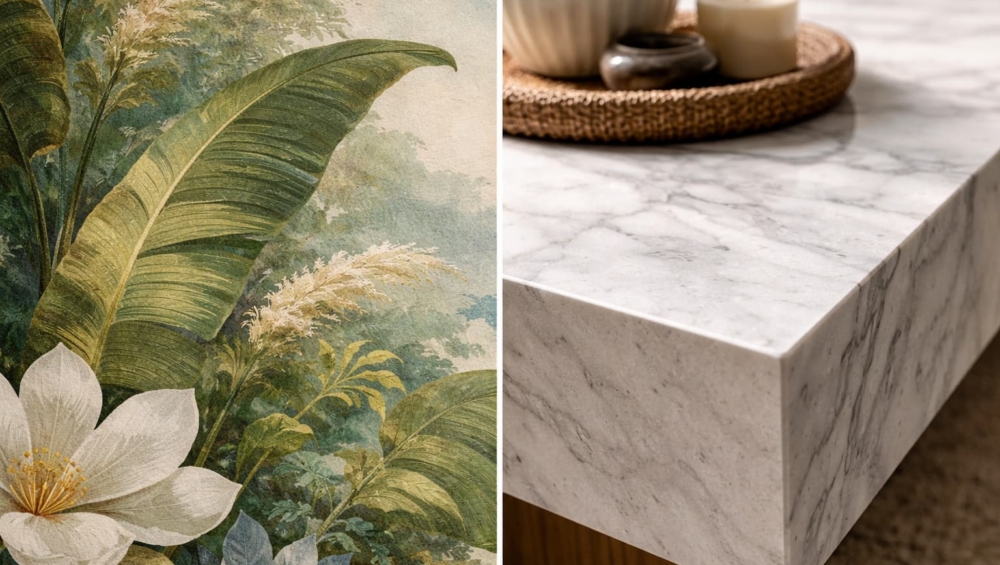
Modern urban living in cities like Jakarta often severs our ancient connection to the wilderness. Consequently, we spend 90% of our lives inside concrete boxes, staring at digital screens. In response, the world of high-end architecture is pivoting toward a movement that restores this broken bond. We call this Biophilic Design.
Actually, this isn’t just a “pretty” trend involving leaf prints; it represents a fundamental shift in how we engineer our living environments for mental health. Specifically, luxury homeowners are now using botanical wallpapers as a primary tool to invite the “outside in.” Therefore, we created this guide to explain the psychological science behind these natural patterns.
1. The Psychological Power of the “Green View”

Primarily, our brains are hardwired to respond to nature. According to evolutionary psychology, the human eye recognizes green hues and leaf patterns as signs of life and resources. As a result, when you cover a focal wall in a lush, botanical print, your nervous system immediately shifts from “alert” to “rest.”
Specifically, looking at nature-inspired patterns lowers cortisol levels (the stress hormone). Moreover, these visuals reduce heart rate variability, which helps you recover from a long day of high-stakes decision-making. By replacing a cold, white wall with a rich forest mural, you create a “Visual Sanctuary.” Ultimately, your home stops being just a building and starts functioning as a tool for emotional regulation.
2. Embracing Organic Forms Over Rigid Lines
In addition to color, the geometry of your home matters deeply. Usually, modern construction relies on sharp 90-degree angles and flat surfaces. Unfortunately, the human brain finds these “unnatural” shapes exhausting to process over long periods. Consequently, designers are now introducing organic forms through wallcoverings to balance the room.
Specifically, botanical wallpapers offer “Fractal Patterns”—shapes that repeat at different scales, just like real trees and ferns. Because these shapes mirror the complexity of the natural world, our eyes process them with less effort. Therefore, a room filled with organic forms feels more harmonious and “soft” to the human psyche. Thus, you achieve a sense of luxury that feels effortless rather than forced.
3. Reconnecting Your Interior to the Natural Rhythm

Finally, we must address the concept of reconnecting your interior to the biological clock. Specifically, natural light and natural patterns help regulate our circadian rhythms. By using botanical wallpapers that feature deep greens and earthy browns, you ground the room in a primal palette.
Actually, at Home Decor Indonesia, we see a massive surge in homeowners asking for “Nature-First” aesthetics. Whether you choose a subtle palm leaf texture or a dramatic tropical mural, you are choosing to prioritize your well-being. In fact, these patterns act as a psychological bridge. By surrounding yourself with these elements, you remind your subconscious that you are part of a larger, living ecosystem. Consequently, you feel more grounded, more creative, and more at peace within your own four walls.
Conclusion: Luxury is Now Measured in Wellness
Ultimately, the rise of botanical wallpaper proves that true luxury has moved beyond “Gold and Marble.” Instead, the new standard of high-end living focuses on how a space makes you feel. By embracing Biophilic Design, you invest in a home that nurtures your mind as much as it protects your body.