English
 Bahasa Indonesia

We live in a loud, fast-paced world. Our phones buzz constantly, emails pile up, and open-plan living-while beautiful-often strips us of privacy. Consequently, our homes often feel more like busy train stations than places of rest.
We need to reclaim our space. Specifically, we need to design intentional zones that force us to slow down. We need sanctuaries.
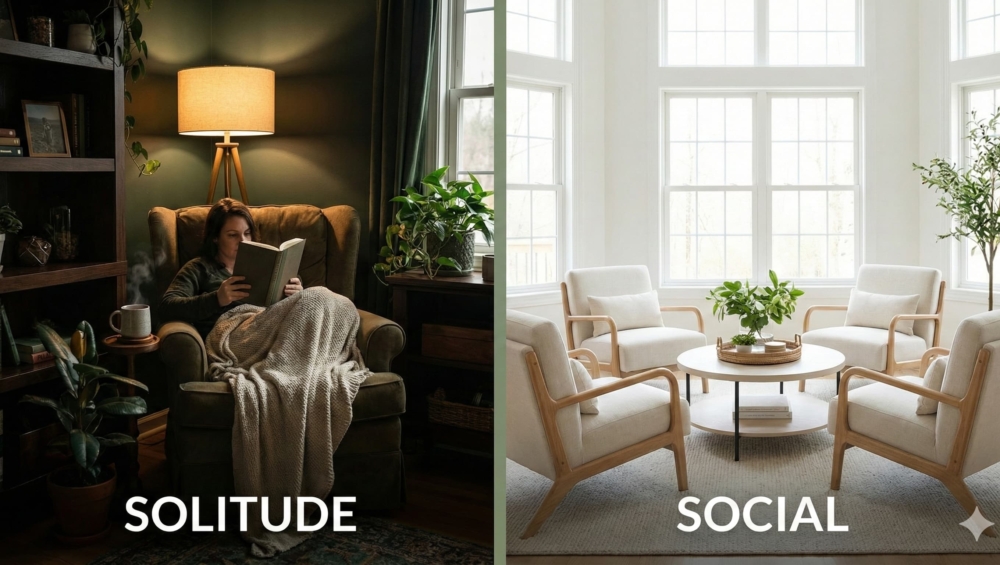
You don’t need a massive mansion to achieve this. You simply need to understand the psychology of space. Therefore, we will explore how to carve out two distinct zones in your home: the solitary escape (the reading nook) and the social hub (the conversation circle).
Ready to transform your home into a retreat? Let’s get to work.
How to Design Reading Nooks and Conversation Circles
The Art of the Reading Nook

Let’s start with the selfish part. Everyone deserves a spot that belongs solely to them. A reading nook serves as your physical “Do Not Disturb” sign. However, throwing a chair in a random corner does not cut it. You must engineer the space for psychological safety.
First, look for enclosure. Humans naturally seek “refuge.” Thus, tuck your chair near a window, beside a bookshelf, or under a slanted ceiling. This positioning protects your back and lets you survey the room. Instantly, your nervous system relaxes.
Next, master the lighting. Overhead lights kill the mood. Instead, use a dedicated floor lamp or a sconce with a warm bulb (2700K). This creates a pool of light that separates you from the rest of the dark room. Furthermore, don’t forget the “landing strip.” You need a tiny side table for your tea or book. Without it, you will constantly lean forward to put things on the floor, breaking your state of relaxation.
The Psychology of the Conversation Circle

Now, let’s flip the script. How do you design for connection? You build a conversation circle.
Unfortunately, most modern living rooms suffer from “TV-centric” design. We point every single piece of furniture at the television. As a result, we stop looking at each other. To fix this, you must break the grid.
A true conversation circle forces eye contact. Specifically, you should arrange seating face-to-face, not shoulder-to-shoulder. Place two armchairs opposite the sofa, or arrange four chairs in a tight ring around a round coffee table.
Moreover, keep the distance intimate. Ideally, keep the knees of people sitting opposite each other about 18 to 24 inches apart. This proximity encourages people to lean in and lower their voices. Consequently, the chat becomes deeper and more personal.
The Hybrid Solution for Small Spaces

But what if you lack the square footage for two separate zones? In that case, you master the hybrid approach. We call this the reading nook conversation circle concept.
This strategy relies on flexibility. For example, use a pair of high-quality swivel chairs.
-
During the day: Swivel the chair toward the window or the bookshelf. Now, it acts as your private isolation pod.
-
At night: Swivel the chair inward to face the sofa. Suddenly, it joins the party and completes the social circle.
Ultimately, this approach allows your room to breathe and adapt to your changing needs throughout the day.
Conclusion: Design with Intention
Furniture placement dictates behavior. If you point chairs at a TV, people will watch TV. If you point chairs at a window, people will reflect. If you point chairs at each other, people will connect.
Therefore, stop letting the room dictate your life. Take control of your layout. Create your sanctuary today.