English
 Bahasa Indonesia

Many people buy a dining table based purely on its beautiful color. Actually, purchasing the wrong geometric shape completely ruins the daily traffic flow of your home. Consequently, you bump into walls and drop hot dishes during busy family gatherings. Instead, you must treat your dining room as a strict architectural puzzle.
At Home Decor Indonesia, we analyze furniture through advanced spatial metrics. Therefore, we created this analytical, conversational guide to help you master the geometry of your dining space.
Ready to engineer the perfect dinner party? Let’s break down the spatial science!
1. The 90 cm Golden Rule of Traffic Flow

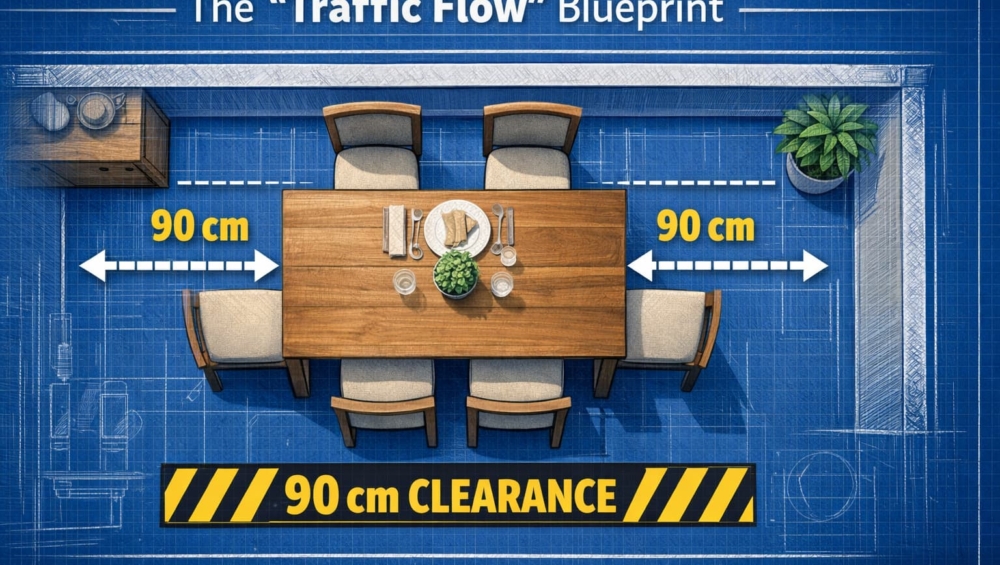
First, you must memorize the ultimate rule of spatial dynamics. Specifically, you need exactly 90 cm (about 36 inches) of empty clearance between the edge of your dining table and the nearest wall.
Because human ergonomics demand this exact measurement, it allows your guests to push their chairs back comfortably without scratching your paint. Furthermore, this precise distance creates a dedicated “service lane” around the perimeter. Consequently, you can easily walk behind seated family members to serve massive holiday meals without awkwardly squeezing past them. Ultimately, ignoring this critical metric traps your guests and destroys the room’s functionality.
2. The Psychology of the Round Table
Next, let us examine the psychological impact of geometric shapes. Usually, a round table serves as the ultimate social equalizer.
Because it completely lacks sharp corners or a distinct “head,” it naturally forces everyone to face the absolute center. Consequently, this circular geometry creates a highly intimate, inclusive environment where everyone makes direct eye contact. Therefore, we highly recommend round tables for square rooms or for families who prioritize deep, engaging dinner conversations over formal hierarchy.

3. The Linear Hierarchy of Rectangular Tables
On the other hand, long, narrow rooms require completely different spatial dynamics. Here, the rectangular table absolutely dominates the space.
Specifically, this linear shape establishes a clear visual hierarchy, often designating a formal “head” of the table. Moreover, straight edges maximize the physical seating capacity along the sides, making it the perfect mathematical choice for hosting massive dinner parties. If you possess a long dining room, you should explore our structural collections and Evaluate our rectangular dining table options to anchor your architecture perfectly.

4. Visual Weight vs. Physical Size
Additionally, you must understand the distinct difference between physical dimensions and visual weight. Actually, a solid, thick oak table absorbs natural light and looks incredibly massive in a room.
In contrast, a dining table featuring a glass top and thin metal legs allows light to pass directly through it. Therefore, even if both tables share the exact same physical measurements, the glass table tricks your brain into perceiving much more open space. Thus, you must match the material density to the overall size of your room to prevent a cramped feeling.
5. The Physical Tape Test Protocol
Finally, you must physically test these geometric theories before you buy anything. Instead of guessing the spatial dynamics, you should use blue painter’s tape to draw the exact table dimensions directly onto your floor.
By executing this simple physical test, you literally verify the 90 cm clearance rule in real-time. Ultimately, doing your mathematical homework guarantees a flawless fit, and trusting the premium engineering at Home Decor Indonesia ensures your dining room looks absolutely spectacular!
Conclusion: Engineer Your Entertaining Space
In conclusion, building the perfect dining room requires logical analysis and precise measurements. Ultimately, you must respect the 90 cm traffic rule and choose a shape that matches your social lifestyle. By applying these spatial dynamics, you transform every meal into a world-class experience!